TL:DR
- Aave DAO voted unanimously, with 100% of votes in favor on Nov 9, 2026 to enable native Bitcoin as collateral on Aave V4 through Babylon Trustless Bitcoin Vaults (TBV). Bitcoin holders will be able to self-custodially lock their native Bitcoin and borrow USDT, USDC and other supported assets through Aave. No wrapping, bridging, or tri-party agreement. Their title to native Bitcoin is retained.
- The collateral factor and interest fees on borrowed assets are as competitive as for other wrapped assets (WBTC and cbBTC) on the Aave V4 Core Spoke.
- Aave DAO will share its revenue from this integration with Babylon, plus a portion towards AAVE and BABY buybacks.
- The ARFC is the result of thorough code reviews by 10+ teams and months of testing.
- This integration unlocks a whole suite of applications using native Bitcoin (BTC) as collateral.
- The next step will be the final AIP stage to activate the integration on Ethereum mainnet.
“Strong start by enabling real Bitcoin as collateral on Aave,” Aave founder Stani Kulechov wrote during the Temp Check.
1. The Problems This Integration Will Solve
Borrowing is a basic financial instrument. Yet, to date, to borrow against their Bitcoin, Bitcoin holders always have to send their Bitcoin to a third-party, such as a centralized lender, a wrapper, a bridge, or a custodian with tri-party escrow agreement.
This introduces assorted risks: counterparty risk, custodian risk, rehypothecation risk, and censorship risk. In addition, in some cases the Bitcoin holder will lose title to their Bitcoin, incurring accounting complications.
On top of that, when using a centralized lending service, Bitcoin holders may also face unfavorable borrowing terms, such as high borrowing costs, opaque fees, and low LTV.
Babylon-Aave V4 integration approved by this ARFC aims at solving these problems:
- Babylon Trustless Bitcoin Vaults (TBV) allows any Bitcoin holder to lock their native Bitcoin in self-custodial Bitcoin vaults (BTCVault) and use them in Aave V4 as collateral, with liquidation fully programmed and autonomously operated by smart contract logic. This removes the need for wrapping, bridging, and centralized intermediaries, and also allows the native Bitcoin holder to retain title over their Bitcoin.
- Aave provides one of the best on-chain, decentralised, disintermediated borrowing and lending markets with the most competitive borrowing terms.
- Llama Risks’ response to this ARFC confirms that native Bitcoin collateral will receive favorable borrowing terms on Aave V4.
2. An Overview of the Approved Integration
The ARFC approves the configuration that brings native Bitcoin collateral to Aave V4 on Ethereum mainnet. Bitcoin holders borrow through a new Babylon Spoke, and a BTCVault Swap Spoke autonomously settles liquidations.
Liquidity comes mainly from Aave's Core Hub, which starts with $21M in stablecoin credit lines across USDT, USDC, GHO, USDG, RLUSD and WBTC, and will increase progressively. A dedicated Babylon Hub is also approved, allowing liquidity providers who only want to be exposed to native Bitcoin collateral to deposit through this hub.
In terms of parameters, native Bitcoin will get:
- A 78% collateral factor.
- A risk premium of 0%, meaning that native Bitcoin collateral is not considered to carry additional risk and therefore does not incur any additional borrowing interest.
3. Commercial Terms
The ARFC confirms that Aave DAO will share a portion of its revenue from this integration with Babylon, as well as allocate a portion towards BABY and AAVE token buybacks.
Details:
- For every 12-month period after the mainnet launch of this integration, Aave DAO will retain the first $500K in revenue and will share the revenue beyond this first $500K with Babylon.
- A portion of the integration’s revenue beyond certain agreed thresholds will also be allocated towards BABY and AAVE token buybacks.
- The split is tiered, starting with 78% Aave - 18% Babylon - 4% buyback fund for the annual revenue between $500K and $2M, and ending with 61.5% Aave - 31.5% Babylon - 7% buyback fund for any annual revenue beyond $6M.
- 85%/15% of the buyback fund will be allocated towards AAVE/BABY token buybacks, respectively.
4. A Rigorously Audited and Tested Integration
Security is of the utmost importance for both Babylon and Aave.
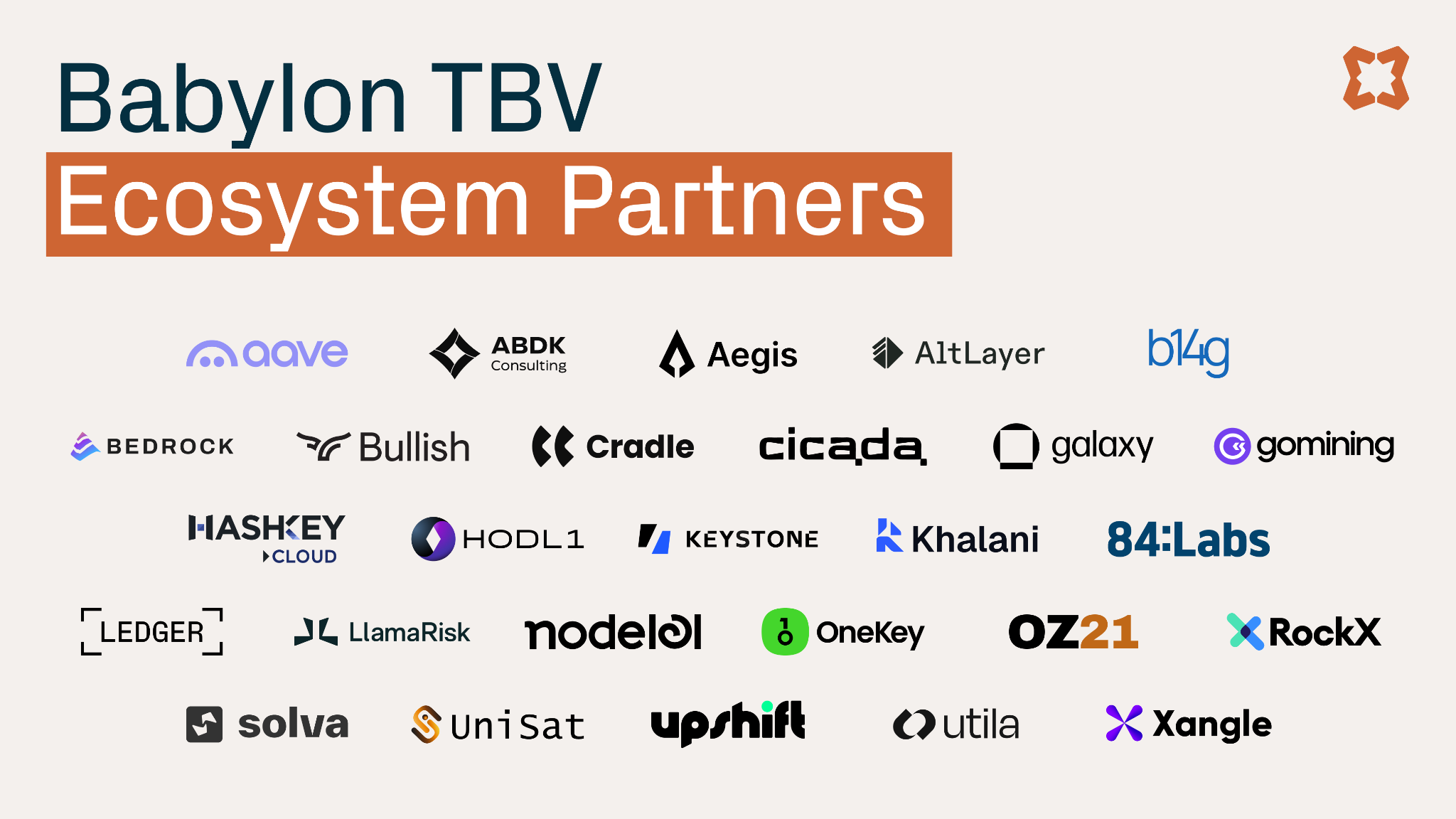
Babylon has engaged with a deliberately diverse group of 6 security firms for multiple rounds of audit of the TBV and the full-stack Aave V4 integration. The group consists of leading generalist auditors, as well as specialists in cryptography, Bitcoin, and formal verification: ABDK, Coinspect, Runtime Verification, Sherlock, Zellic, and zkSecurity.
In parallel, four teams from Aave DAO have also assessed the integration, including Aave Labs security team, Llama Risk, Certora, and Aave Labs’ external security advisor.
Babylon has also heavily engaged AI for security. The team has built Zarqa, its in-house AI auditor, to continuously audit the codebase and infrastructure. The team also deployed third party AI audit tools, including Cantina's Apex, CodeRabbit, and zkao.
The protocol and this integration have also been moving through increasingly open testing environments. A private alpha testnet was launched in February 2026, validating an early version of the protocol. It was followed by a public testnet launched in June 2026, which has been upgraded continuously following feedback from users and ecosystem projects, so every improvement is exercised in a live setting.
5. Seeding the Native Bitcoin Credit Market
Babylon-Aave V4 integration will also unlock a suite of native Bitcoin credit products.
Currently deployed on testnets include:
- Aegis’ fixed-rate borrowing dApp for native Bitcoin holders, which leverages stablecoin vaults to hedge Aave’s variable rates.
- Cradle’s options DEX, which allows native Bitcoin holders to generate yield by selling covered call spread options against their Bitcoin; the spread is settled by leveraging Aave’s deep liquidity.
Furthermore, the integration also allows native Bitcoin holders to generate yield by deploying the borrowed stablecoins into yield opportunities and earning the carry. Through TBV's modular resolver framework, Bitcoin holders can access a variety of yield strategies without giving up custody of their Bitcoin. Resolvers enable different integrations, such as credit delegation to risk curators and asset managers, automated yield strategies through ERC-4626 vaults, and more, allowing users to generate yield.
6. What Happens Next
The proposal now moves to an AIP, Aave’s final stage before deployment to the mainnet. Once completed, mainnet is targeted for late 2026, subject to change and confirmation.
For security, mainnet launch will be staged, starting from a restricted phase which limits the number of participants and volume. We will publish the mainnet schedule and staged rollout plan in the coming weeks.
Learn more about TBV: https://babylonlabs.io/trustless-bitcoin-vaults
Disclaimer
This announcement describes a governance proposal and planned integration. Deployment and availability remain subject to final governance approval and launch readiness. Borrowing against BTC involves liquidation risk, and protocol or network failures may result in losses or delayed access to collateral. Any terms in this article do not guarantee borrower demand, revenue, token purchases or returns. Token purchases do not guarantee price appreciation or returns.