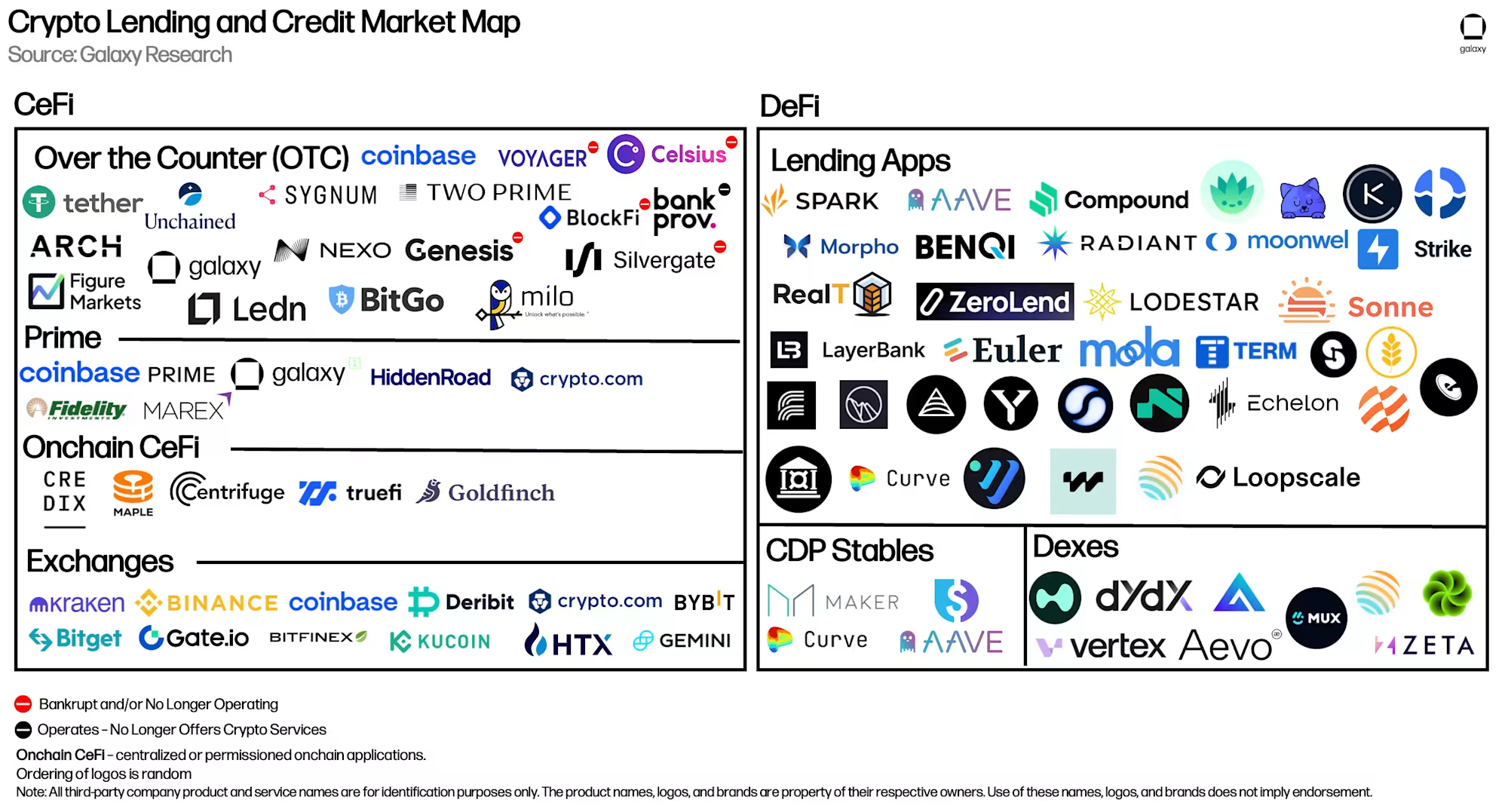
Across the broader crypto-collateralized lending market, Galaxy Research reported $56.16 billion at the end of Q2 2026: $22.98 billion in CeFi open borrows, $20.43 billion in outstanding loans on DeFi lending applications and approximately $12.75 billion in crypto-collateralized portion of CDP stablecoin supply.
Bitcoin-backed borrowing is a small part of this, even though Bitcoin holders have borrowed against Bitcoin for years. SkyQuest estimates the Bitcoin loan market at $3.58 billion in 2025 and forecasts growth to $21 billion by 2033. The estimated Bitcoin loan market remains small relative to Bitcoin’s roughly $1.5 trillion market capitalization. That is about 0.24% of Bitcoin’s market value.
By its properties, Bitcoin should support a much larger loan market. Bitcoin is deeply liquid, globally held and available 24/7. Those are exactly the properties you want in a collateral asset. For lenders, liquidity and continuous trading support collateral valuation and liquidation. For holders, borrowing provides cash or stablecoins without selling their Bitcoin.
The constraint is how holders can borrow. Historically, most large-scale Bitcoin-backed borrowing has relied on one of two methods. You can use a centralized lender or you can wrap your Bitcoin to reach on-chain lending markets. Both work for holders, and neither is free.
So the question is not whether you can borrow against Bitcoin. You can, today. The question is whether you can see the price. In this article, price refers to the full costs and trade-offs of the borrowing model, not just the headline interest rate.
What a centralized lender is charging you for
With a centralised lender, the total cost is not always captured by the interest rate. The borrower transfers Bitcoin to the lender or its custodian. Loan terms include the interest rate, allowed LTV and any processing fees. Access also depends on identity checks and jurisdictional eligibility.
Published rate cards give a view of the market. Galaxy’s retail credit line, launched in August 2026, is priced at a variable 8.99% APR, with a maximum origination LTV of 50%. Ledn’s published rate table lists 11.49% for loans below $250,000 and 9.25% for loans of $2 million or more. Ledn also lists a typical initial LTV of 50% and a $500 minimum loan. The lowest advertised rates can also require materially lower LTVs or exposure to a platform token. Nexo's advertised 1.9% rate requires an LTV below 20%, together with Platinum status and at least 10% of the portfolio held in NEXO tokens under Nexo Loyalty Program.
So what are you paying for?
Custody, balance-sheet capacity, liquidity and liquidation infrastructure. In exchange, your Bitcoin is held by the lender or its custodian for the life of the loan.
By comparison, Aave v4 uses a shared, market-based variable rate for each borrowed asset. Pricing follows protocol rules rather than individually negotiated loan quotes or platform-token loyalty tiers.
Going on-chain changes the risk model, but does it remove the cost?
On-chain Bitcoin exists in multiple tokenised forms
On-chain lending markets use several wrapped representations of Bitcoin. WBTC is the largest, with roughly $9 billion in circulation as of September 2026, according to CoinGecko. Other major representations include cbBTC, FBTC and tBTC. These assets form much of the Bitcoin collateral base in DeFi. In Token Terminal’s July 2026 report, WBTC and cbBTC accounted for 10.1% and 6.0% of Aave’s total value locked (TVL), respectively, or 16.1% combined.
What you post as collateral in these markets is not native Bitcoin. It is a token issued under another system. WBTC can be bought, swapped or borrowed without using its mint-and-burn process. At the issuance and redemption layer, however, only identity-verified institutions approved through WBTC governance can mint and burn WBTC. A holder seeking direct redemption into native Bitcoin therefore depends on an authorized merchant and WBTC’s custodial system.
The market has already shown what that trust is worth. In August 2024, BitGo announced plans to transfer management of WBTC to a joint venture with BiT Global and move from US-based custody to a multi-jurisdictional model. The announcement prompted Aave risk contributors from the Aave governance to review the implications for WBTC. WBTC did not need to fail for the market to reassess the collateral. A proposed change in the trusted parties was enough.
Bridges have been among the most costly attack vectors in digital assets. According to DefiLlama data cited by Bloomberg, 26 of the 250 hacks recorded so far in 2026 targeted bridges and cross-chain infrastructure. If the system backing a wrapped asset fails, the token posted as collateral can remain on-chain even if access to the underlying Bitcoin is impaired.
Tokenizing Bitcoin does not eliminate third-party or protocol risk. It changes its form. A centralized lender can fail. A custodial token depends on its issuer and custodian. Other designs may depend on signer sets, bridge contracts or cross-chain messaging.
None of this is permanent. The intermediary exists because native Bitcoin could not previously verify repayment and liquidation events on another chain. Removing that limitation means the intermediary can also be removed.
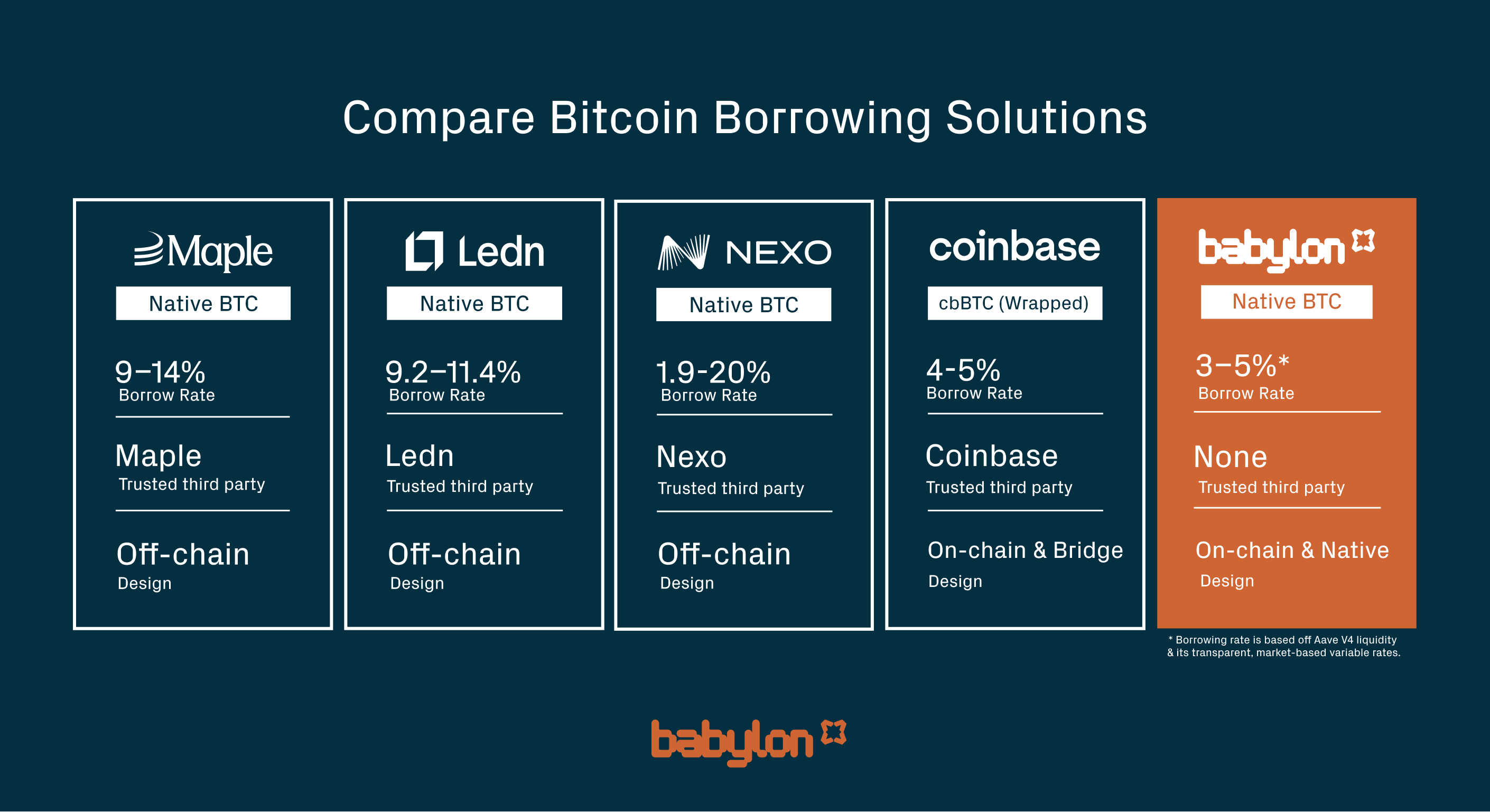
Native and trustless together
Babylon Trustless Bitcoin Vaults (TBV) let native Bitcoin be used as collateral without wrapping, bridging or intermediaries. To use Bitcoin as collateral on Ethereum, each depositor creates a self-custodial BTCVault by locking their native Bitcoin in a dedicated UTXO on the Bitcoin network. Redemption is trustless and is authorised by a proof and challenge process.
This native and trustless end-to-end process re-prices borrowing. There is no Bitcoin custodian to pay for and no wrapped-asset issuer to redeem through.
Here is how native Bitcoin-backed borrowing through Aave v4 works. The flow is available on Babylon’s TBV public testnet app using test assets.
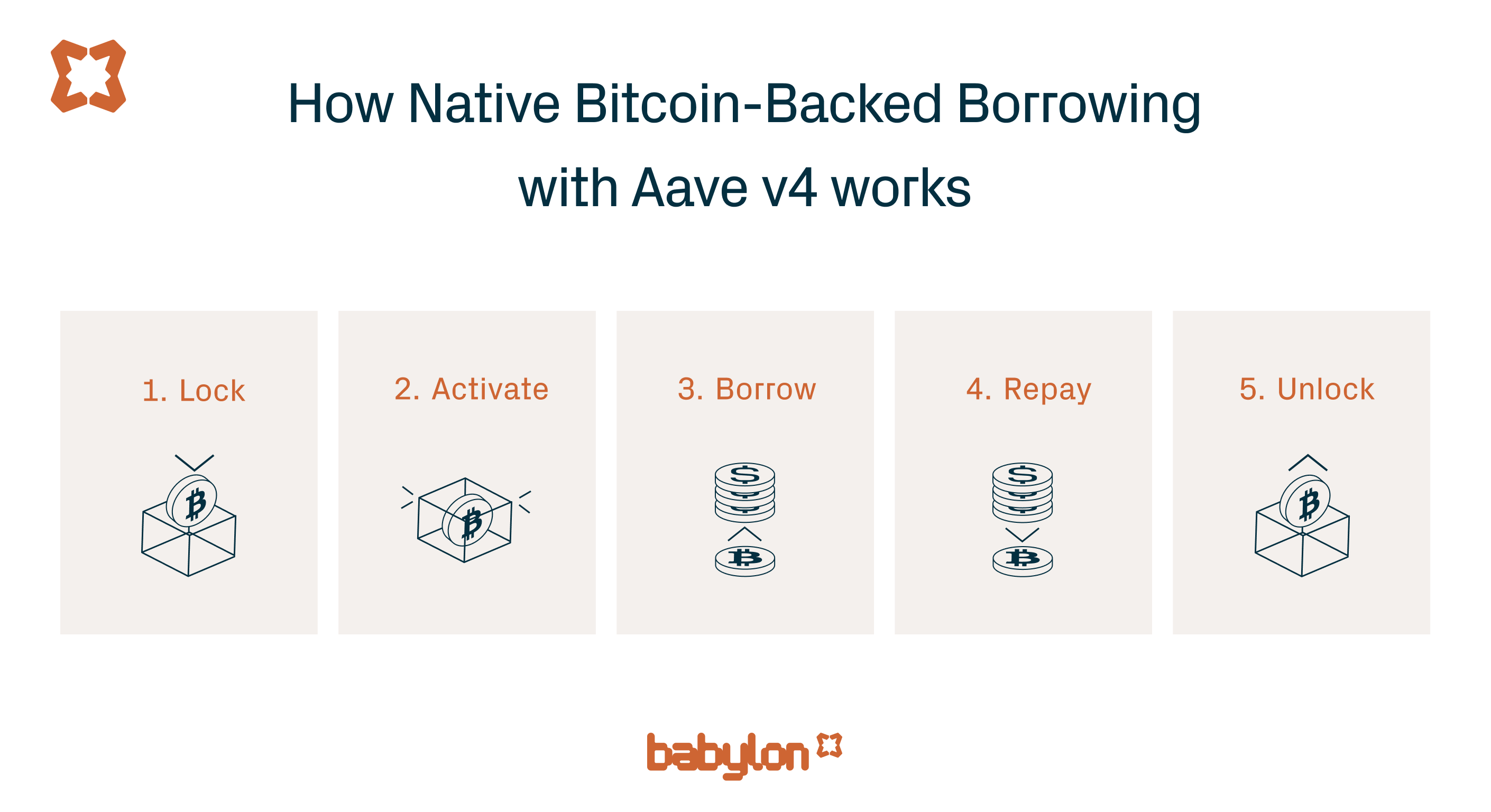
- Lock. You lock native Bitcoin on the Bitcoin network. While the transaction receives confirmations, participants construct and pre-sign the transaction graph that fixes every permitted spending path.
- Activate. Once setup is complete, the self-custodial BTCVault is activated on Ethereum and Aave v4 can recognise the Bitcoin as collateral.
- Borrow. You borrow supported assets through Aave v4 at market-based variable rates.
- Repay. To close the position and withdraw all of your Bitcoin, you repay all outstanding debt and accrued interest, then request withdrawal. (Liquidation happens only if the position falls below the liquidation threshold. Partial liquidation is supported.)
- Unlock. Your withdrawal is checked through a challenge process on Bitcoin. If no valid challenge is raised, your Bitcoin returns to your nominated address.
Why this is possible now
Efficiently verifying zero-knowledge proofs on Bitcoin has been a long-standing problem. With BitVM2, disputing a claim could require more than $14,000 in on-chain fees. BitVM3 reduced the on-chain cost but required a 42 GiB garbled circuit for each instance. BABE retains BitVM3's lower on-chain costs and reduces off-chain storage and setup requirements by more than 1,000x. This is achieved by using witness encryption for linear pairing relations instead of garbling the full Groth16 verifier.
That makes cryptographic enforcement more practical. During the BTCVault setup, participants pre-sign a Bitcoin transaction graph that fixes the permitted ways the Bitcoin can be spent. Redemption of Bitcoin is authorized by an Ethereum event, whose existence is proven by a zero-knowledge proof, and is protected by a challenge process. The proof and challenge mechanism determine whether the claim can proceed, without relying on any approval from a custodian, wrapped-asset issuer or signer committee.
Borrowing uses Aave v4’s market-based variable rates. Total costs also include applicable protocol, Vault Provider and network fees (Babylon documentation).
Native Bitcoin collateral beyond lending
TBV is designed to support multiple chains and applications and a variety of different use cases. Lending is the first integration and the largest market. In September 2025, DeFi lending reached a record $130 billion in total value locked, making it the largest DeFi sector at the time (DL News, citing DeFiLlama). Lending tests collateral under stress. Prices fall, borrowers face margin pressure and liquidations have to clear.
The same infrastructure is designed to support stablecoin issuance, derivatives, insurance and other applications.
So you’re left with a question. If borrowing against Bitcoin no longer means giving up custody or exchanging it for a wrapped asset, how much longer will Bitcoin remain idle?